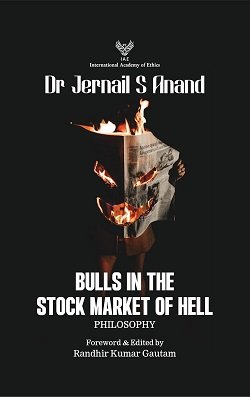
Dr Anand's articles, now compiled in this remarkable book, dissect the intricate
dance between adversity and prosperity, between the mundane and the sublime. He
takes us on a journey through the philosophical landscapes where the human
spirit grapples with the shadows of despair and the glimmers of hope. His
reflections are not just for the erudite or the academically inclined; they are
for anyone who dares to question the status quo and seeks to understand the
deeper currents that shape our lives.
The essence of this book lies in its ability to demystify the complex realities
of life through a language that resonates with simplicity and clarity. Dr
Anand's approach to philosophy is refreshingly grounded, eschewing the esoteric
jargon that often alienates the lay reader. Instead, he invites us to engage
with profound questions in a manner that is both accessible and
thought-provoking.
In Bulls in the Stock Market
of Hell,
Dr Anand challenges us to re-evaluate our perceptions of wealth, happiness, and
success. He explores the dichotomy between the rich and the poor, not just in
material terms but in the richness of spirit and the poverty of values. His
examination of the "stock market of hell" is a metaphorical exploration of the
human condition, where the relentless pursuit of wealth often leads to moral and
spiritual bankruptcy.
One of the most compelling aspects of Dr Anand's writing is his ability to weave
together philosophy and poetry. He understands that philosophy, when stripped of
its musicality, can become dry and inaccessible. By infusing his prose with
poetic sensibility, he not only makes philosophical concepts more palatable but
also more impactful. His writing sings with the rhythm of life itself, capturing
the nuances of human emotion and the subtleties of thought.
Dr Anand’s insights often remind one of the profound reflections of existential
philosophers such as Jean-Paul Sartre and Albert Camus. In discussing the
ennobling effect of tragedy, Anand writes, “Tragedy is not a single event in the
life of a man. Sometime when it is prolonged, it turns into adversity. Adversity
is a blessing in disguise, it is often held, because
suffering has an ennobling effect on men.” This mirrors Camus’ assertion
in The Myth of
Sisyphus
that “The struggle itself toward the heights is enough to fill a man's heart.”
Furthermore, Anand’s critique of societal divisions and the inherent inequities
resonates with the works of Karl Marx. His observation, “While these millions
are struggling in unwholesome conditions, some people enjoy the fruits of their
labour, and own the maximum wealth of the earth,” echoes Marx’s critique of
capitalism and the alienation of the proletariat.
In his exploration of ‘the illusion of free will’, Dr. Anand states, “Man is
made to play on a foreign pitch, and yet forced to say that it is ‘his’ choice.”
This sentiment is reminiscent of Sartre’s notion of bad faith, where individuals
deceive themselves to escape the anxiety that comes with true freedom and
responsibility.
Dr Anand’s contemplation on ‘the techno man and the existential threat posed by
unchecked technological advancement’ resonates deeply with the works of
contemporary thinkers such as Yuval Noah Harari. Anand writes, “The techno-man
is emerging as the villain who is proving a threat to the existence of nature,
and God, and finally to his own existence,” drawing parallels to Harari’s
concerns in Homo Deus about humanity’s future in the face of rapid technological
evolution.
Moreover, his exploration of human emotions and artistic expression in “Art:
Fabulating the Forbidden Dreams of Mankind” draws a poignant comparison to Oscar
Wilde’s thoughts on art and reality. Anand’s assertion, “An artist alters them,
and then, displays them after he has dressed them in a new makeover, so as to
evolve a point of view,” echoes Wilde’s famous declaration that “Life imitates
Art far more than Art imitates Life.”
In “Demystifying the Ideas of Good and Evil: Humanizing Philosophy,” Anand
addresses the concept of good and evil with a clarity that resonates with the
moral inquiries of Immanuel Kant. Anand writes, “We can come down to simple
equations in order to find out what to do and what not to do,” reminding us of
Kant’s categorical imperative, which emphasizes that moral actions are those
that can be universally
applied.
In “Resetting the Divine Algorithm: Crying ‘Halt’ to the Tale Told by an Idiot,”
Anand explores the consequences of human actions on nature, invoking a thematic
parallel with the environmental warnings of Rachel Carson. Anand’s poignant
reflection, “Nature, I think, erred in not granting this consciousness of right
and wrong to natural objects,” underscores the necessity of a harmonious
coexistence between humanity and nature, much like Carson’s plea in Silent
Spring.
In “Creating an Estate of Happiness for Yourself,” Anand’s reflections on the
pursuit of wealth versus the pursuit of happiness find a counterpart in the
writings of Henry David Thoreau. Anand posits, “If your preference is for
Wealth, then all your pursuits are fine. But don’t blame gods if your son
develops some problem, or your daughter elopes with someone,” reminiscent of
Thoreau’s advocacy for a simpler, more meaningful life in Walden.
This book is a testament to Dr Anand's profound understanding of the human
psyche and his ability to articulate the inarticulate. It is an invitation to
pause, reflect, and embark on a journey of self-discovery. It is a call to look
beyond the surface and explore the deeper truths that lie beneath the veneer of
everyday existence.
As you delve into the pages of
Bulls in the Stock Market of
Hell, I encourage you to open your mind and heart to the possibilities
that Dr Anand presents. Allow his words to challenge your assumptions, to
inspire new ways of thinking, and to illuminate the path to a more meaningful
existence.
Dr Jernail Singh Anand's work is a gift to us all, a reminder that even in the
‘Stock Market of Hell’, we can find moments of grace, insights of profound
clarity, and the strength to rise above the turmoil. This book is not just a
collection of articles; it is a journey into the depths of the human soul,
guided by a philosopher who understands that true wisdom lies in the ability to
see the extraordinary in the ordinary.