In his book Bunch of Thought, RSS Chief M.S. Golwalkar wrote that increasing the population in strategically important areas of the country is a second front in their attack. After Kashmir, Assam is their next target. On November 19, 2005, RSS Chief K.S. Sudarshan stated that Hindus should not follow the policy of having one or two children. He argued that if this policy continued for the next 120 years, there would be no heirs left in Hindu families. Therefore, he urged Hindus to have at least five children, and a maximum of sixteen. On January 7, 2015, BJP MP Sakshi Maharaj expressed similar concerns at a religious gathering in Meerut, saying that the concept of having four wives and forty children would not work in India. He emphasized that Hindu women should have at least four children, with one of them dedicated to the RSS.
Building on this idea, Shyamal Goswami,
Joint President of the RSS in Birbhum, West Bengal, urged Hindu women to have no
fewer than five children. He warned that if they did not, the population balance
would be disturbed in the future. He stressed that for the protection of
Hinduism and Sanatan Dharma, it is necessary for all Hindus to have five
children.
The above statements create confusion and
fear among Hindu society, leading them to easily believe that Islam not only
allows Muslim men to practice polygamy but also prevents them from engaging in
family planning. As a result, they fear that one day the Muslim population in
India will surpass the Hindu population, leading to a situation where Muslims
will again rule over India. Meanwhile, a new slogan called "Love Jihad" has
emerged, which is also based on the fabricated theory of Muslim population
growth. The idea behind this theory is that Muslims are supposedly increasing
their population in a planned manner to eventually take control of India's
political power.
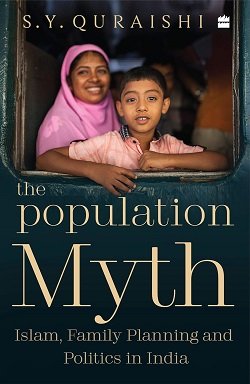
The book
The Population
Myth: Islam, Family Planning, and Politics in India provides a
factual investigation into whether this manufactured theory about Muslim
population growth is real or if there are other motives behind it.
The author of the book is Dr. S.Y.
Qureshi, former Chief Election Commissioner of India. Dr. Qureshi states that
this book is the result of 25 years of hard work. The book’s preface has been
written by population and development analyst Shri Devendra Kothari, and the
former Chairman of the National Commission for Minorities, Shri Tahir Hussain.
Many scholars have provided feedback on the book, with one of the notable
responses coming from Shri N.C. Saxena. He wrote that population growth depends
more on factors like poverty, the status of women in society, and access to
healthcare, rather than religion. He uses Bangladesh as an example, where better
healthcare services and a balanced gender ratio have led to a sharp decline in
population growth. In India, he points out that the growth rate of the Muslim
population in Kerala is lower than that of Hindus in states like Uttar Pradesh
and Rajasthan. The key reasons for this are that people in Kerala often marry
within their community, and the practice of dowry is less prevalent, so girls
are not considered a burden. Shri Saxena expressed hope that Dr. Qureshi’s book
would help clear the misconceptions and biases surrounding Muslim population
growth, which have been spread due to vested interests.
The book is based on nine chapters. The
first, second, and third chapters provide a historical analysis of family
planning in India. These chapters explore how India developed family planning
policies after independence, their impact on population growth, who adopts
family planning, and the socio-economic reasons behind it. The fourth chapter
focuses on the status of family planning among Muslims. The fifth chapter
discusses what Islam says about family planning. It examines the teachings of
the Quran and Hadith on this issue. This chapter presents verses from the Quran
and Hadith that are often cited by religious leaders to oppose family planning.
However, it also highlights the majority of verses that encourage family
planning in Islam. In this chapter, it is confirmed through newspaper reports
that the widespread belief about Muslim religious scholars opposing family
planning and vaccination campaigns is incorrect. On the contrary, these scholars
actually encourage government initiatives related to family planning and
vaccination.
The sixth chapter provides a comparative
and factual overview of family planning policies in Islamic countries. The
seventh chapter focuses on the perspectives of major world religions on family
planning. It discusses how different religions approach the issue of family
planning. The eighth chapter focuses on the communal politics surrounding family
planning in India. It presents statements from leaders and ideologues of
organizations like the RSS, Janata Party, and Hindu Mahasabha. Dr. Qureshi
explores whether the narrative of "Muslim appeasement" is merely a tactic to
instill fear among Hindus or if there is any real basis to it. The ninth chapter
presents conclusions and outlines the way forward. Dr. Qureshi highlights that
India was the first country in the world to adopt a family planning policy after
gaining independence.
Dr. Qureshi explains that while
population explosion is often seen as a problem, it can also be a potential
advantage for a country, provided that a large portion of the population is part
of a skilled workforce. In other words, the more skilled artisans and
professionals a country has in its labor force, the higher its productivity will
be, which can make it a leader in global development. He uses the example of
India, where the number of unskilled workers far outweighs the skilled ones.
Despite having a large youth population, India is not fully utilizing its
workforce due to a lack of skills. In India, only 4.69% of the total workforce
is skilled, compared to 24% in China, 52% in the USA, 68% in the UK, 75% in
Germany, 80% in Japan, and 95% in South Korea. Due to this lack of skill, even
though India has a large population, it is unable to convert its population
numbers into resources for growth and development. In the book, Dr. Qureshi
presents a detailed and factual analysis of population growth and family
planning policies. He points out that while the decade-wise population growth
rate is consistently declining across all religious groups in India, there are
still regional disparities in people's educational status, access to healthcare,
employment, and women's empowerment
For example, in 1951, the total fertility
rate (the average number of children a woman gives birth to during her lifetime)
for women was 6 children. By 2015-16, this number had dropped to 2 children.
Despite this decline, high birth rates still persist due to the large proportion
of the population in the reproductive age group of 15 to 24 years. Initially,
India launched family planning campaigns with the aim of controlling population
growth. However, after the 1994 International Conference on Population and
Development in Cairo, the focus shifted to population stabilization. Now, the
national target is population stability by the year 2045.
India's first family planning policy was
introduced in 1952. However, due to a lack of resources and healthcare services,
despite the adoption of sterilization, both birth and death rates remained high.
In the 1960s, the national family planning policy focused mainly on
sterilization, but the decade still saw high population growth rates, and there
was reluctance towards sterilization among Muslim families, both male and
female. In the 1970s, the government shifted its focus to family planning and
allocated more funds. Contraceptive methods and education were made available at
primary healthcare centers. The Medical Termination of Pregnancy (MTP) Act was
passed in 1971, which allowed for safe abortion services at healthcare centers.
During the Fifth Five-Year Plan, particularly in 1976, a large-scale
sterilization campaign was conducted, with around 8 million people undergoing
sterilization. During the same decade, the family planning program was renamed
the National Family Welfare Program, which also included infant health services.
In 1978, the World Health Organization
(WHO) issued the Alma-Ata Declaration, pledging to provide health services to
everyone by the year 2000. Following this, India introduced its National Health
Policy in 1983. In the 1981 census, a slight increase of 11.71% was observed in
the Muslim population. Along with this, Muslim couples began to show more
interest in family planning, especially by adopting the policy of spacing
children. According to an ORG (Opinion Research Group) report, 22.5% of Muslim
couples started using some form of family planning. By 1989, the percentage of
Muslim couples adopting family planning methods increased to 33.8%, with 19.1%
opting for sterilization.
In the 1990s, the National Development
Council's report brought changes to the national family welfare policy. Due to
variations in state-level healthcare services and their availability, the family
planning program, which had previously focused primarily on contraceptive
methods, was decentralized to address regional needs. The first National Family
Welfare Survey in 1992-93 assessed national and state-level reproductive rates,
infant mortality rates, trends in family planning adoption, and the availability
of child health services. It was estimated that only 27.7% of Muslim couples
were adopting any form of family planning. In 1997, the Ministry of Health and
Family Welfare initiated the Reproductive and Child Health Program, aiming to
deliver health and family welfare services to women and children according to
their needs. As a result, the 1998-99 National Family Welfare Policy showed that
37% of Muslim couples were using some form of contraception.
The National Population Policy of 2000
aimed to provide contraceptive methods and maternal and child health services to
stabilize the population by 2045. To achieve this, delaying the age of marriage
to a minimum of 18 years for women and 22 years for men was prioritized. The
policy also set targets to reduce the maternal mortality rate to less than 100
per 100,000 live births, prevent sexually transmitted diseases, reduce dropout
rates from education, and achieve a replacement fertility rate of 2.1 children
per woman.
The author conducts a detailed analysis of family welfare and health programs
from the First Five-Year Plan to the Twelfth Five-Year Plan. In the Sixth
Five-Year Plan, he identifies the reasons behind the increase in infant and
maternal mortality rates. He points out that family planning policies were
occasionally targeted in Muslim-dominated districts but were not consistently
implemented in these areas. Due to a lack of political will and the sensitivity
surrounding the issue, policymakers often avoided focusing on family planning in
Muslim-majority areas. On the other hand, the media placed the blame for not
adopting family planning on Islam and Muslims.
India has a long history of introducing family planning policies, but the
"two-child rule" was never enforced before 2020. In local elections, the
two-child rule became a requirement for candidates, but people found new ways to
bypass it. Candidates running for office resorted to practices such as divorcing
their wives, adopting out their children, and even resorting to sex-selective
abortions as a way to comply with the two-child policy. Population stabilization
is based on factors other than religion, such as access to higher education,
healthcare services, employment opportunities, and the availability and variety
of contraceptive methods. These factors have led to better outcomes in
population control.
Within India, states like Kerala, Tamil Nadu, and Andhra Pradesh serve as
examples where improvements in education, healthcare, and family planning
programs have led to successful population stabilization. On the international
level, countries like Indonesia and Bangladesh are good examples, where
investments in women's education, contraceptive methods, and healthcare
services
have resulted in better outcomes for population stabilization and family
planning.
Dr. Qureshi provides a detailed analysis of population growth based on religious
factors, presenting
statistical data to support his points. He notes that in 1951, the Hindu
population was 84.1%, which declined to 79.8% by 2011, while the Muslim
population increased from 9.9% to 14.2%. This indicates that, over a span of 60
years, the Hindu population decreased by 4%, while the Muslim population grew by
4%.
However, in the last decade (from 2001 to 2011), the population growth rate for
Muslims slowed down significantly compared to Hindus. For example, during the
1991-2001 period, the Hindu population grew by 19.92%, but this rate dropped to
16.7% in the 2001-2011 period (a decrease of 3.1%). On the other hand, during
the same period, the Muslim population growth rate fell from 29.9% to 24.6%,
showing a decline of 4.9%. Despite this decrease, the Hindu population growth
rate remained higher.
Two methods are commonly adopted for family limitation: one is permanent
sterilization, and the other is spacing the births of children. According to the
National Family Health Survey (NFHS), it was found that 22% of Hindu couples
adopt sterilization, while 45% of Muslim couples opt for sterilization.
Additionally, in all four rounds of the NFHS, there has been a consistent
difference in the total fertility rate (TFR) between Hindu and Muslim women,
although a significant decline was observed over time. In the first survey,
Muslim women gave birth to, on average, one more child in their lifetime than
Hindu women. By the fourth round of the survey, this gap had decreased to 0.48,
which is less than half a child.
The total fertility rate (TFR) among women is not determined by religion but
rather by economic, social, and educational factors. This can be observed not
only within India but also internationally. For example, in Uttar Pradesh, the
TFR for Hindu women is 2.67 children, whereas in Tamil Nadu, Muslim women have a
TFR of only 1.74 children. In contrast, in Haryana, the TFR rises to 4.15
children. Similarly, when analyzing the four southern states, the TFR among
Muslim women is as follows: Kerala (2.46), Karnataka (2.84), Tamil Nadu (2.57),
and united Andhra Pradesh (2.53). In comparison, Hindu women in states like
Uttar Pradesh (4.76), Madhya Pradesh (3.39), and Bihar (4.4) have higher
fertility rates. This shows that fertility rates cannot be categorized simply by
Hindu, Muslim, or Christian communities.
Dr. Qureshi uses government data from 1992-93 to 2015-16 to demonstrate the
adoption of family planning methods. He shows that the percentage of Hindu
couples using some form of family planning increased from 41.6% to 54.4%,
marking a rise of 12.8%. In comparison, the percentage of Muslim couples using
family planning methods increased from 27.9% to 45.3%, showing a rise of 17.4%.
This indicates that the increase in family planning adoption among Muslims
(17.4%) was higher than that among Hindus (12.8%).
Dr. Qureshi further proves that factors like income level, employment status,
and education have a significant impact on family planning decisions. People
with low income, less education, or who are unemployed tend to have higher
fertility rates compared to those with higher income, better education, and
stable employment.
Dr. Qureshi provides startling statistics that counter the communal claims
suggesting that Islam allows polygamy, leading to population growth among
Muslims. He refers to a 1974 report by the Ministry of Social Welfare, which
shows that the percentage of polygamous marriages among different communities is
not as significant as commonly believed. The report revealed the following
percentages:
Dr. Qureshi also presents data over three decades to further dispel the myth. In
the 1931-1940 period, 7.29% of Muslims practiced polygamy, compared to 6.79% of
Hindus. By the 1941-1950 period, the rate of polygamy among Muslims had declined
to 7.06%, while Hindus saw a slight increase to 7.15%. These figures suggest
that polygamy is not a significant or growing factor in population growth among
Muslims and that it is not practiced at a rate that would contribute
disproportionately to demographic trends. This analysis highlights that polygamy
is not as widespread or significant a factor as often portrayed in communal
discourse, and that demographic changes are driven by a variety of factors, not
just religious practices.
Between 1951 and 1960, the decline in polygamy became even more pronounced. In
this decade, the percentage of polygamous Hindu men was 5.06%, while for
Muslims, it had decreased to 4.31%. Similarly, in
terms of the gender ratio (the number of women per 1000 men), in 1951, India had
946 women for every 1000 men across all religions. By 2011, this number had
dropped slightly to 943 women per 1000 men, meaning that, on average, there is
less than one woman for every man. This indicates that in a society where one
man practices polygamy, another man is effectively deprived of the opportunity
to marry, leading to a gender imbalance.
In the final chapter of the book, titled
"The Way Forward," Dr. Qureshi addresses the claims made by right-wing communal
leaders that Muslims will eventually become the majority in India. He dismisses
these claims, pointing out that they are without merit. To support his argument,
he presents a mathematical model developed by Dr. Dinesh Kumar, the former Vice
Chancellor of Delhi University, and Professor Ajay Kumar of K.R. Mangalam
University. According to their model, even if the Muslim population continues to
grow at a rate of 4% per year, it would take 600 years for the Muslim population
to reach the same level as the Hindu population. Despite all of this, Dr.
Qureshi advises Muslims to take the initiative in adopting family planning, as a
limited family size is the only way to provide children with proper education,
healthcare, and prosperity. He emphasizes that Muslims must overcome the
negative propaganda spread by right-wing communal leaders. They must also work
to change the narrative of fear that has been instilled among Hindus for
political gain.
Dr. Qureshi advises policymakers in
constitutional positions to focus on family planning campaigns and urges Members
of Parliament (MPs) and legislators to raise all relevant questions related to
this issue in Parliament and state assemblies. He suggests that political
parties should include family planning in their manifestos. Additionally, he
advocates for the promotion of the benefits of small families among the public.
He stresses the need to educate the public about the direct relationship between
education, poverty, employment, and access to healthcare with family planning.
Dr. Qureshi calls for the proper use of the Family Planning Fund, ensuring
transparency and accountability. He encourages local governing bodies (like
Panchayats) to advocate for birth spacing, the availability of contraceptive
methods, and to promote the idea of having smaller families in their
communities.
In conclusion, Dr. Qureshi's
book will serve as a reference work not only for general readers but also for
researchers. It will break the myths spread among Hindus about Muslims and
counter the fear-mongering that aims to polarize votes by exaggerating the
growth of the Muslim population. The idea that a larger population automatically
gains control over political power is a fallacy. Whether viewed from an economic
or caste perspective, it is often the minority or less populous groups who hold
power and control resources. This can be seen in the cases of American and
European imperialism, as well as the dominance of upper-caste groups and large
industrialists.
Dr. Qureshi's book can benefit society
even more if translated into Hindi. The reason is clear—while English readership
is limited, the fear of population growth is widely propagated among the general
public. Given the large Hindi-speaking audience, a Hindi translation would have
a greater impact and play a crucial role in dispelling the myths that have been
created.