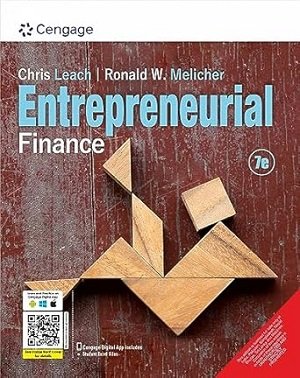
Entrepreneurial finance
applies principles of finance and economics to ventures led by
entrepreneurs, emphasizing value creation, risk management, financial modeling,
and venture valuation. It prioritizes the perspective of the entrepreneur over
traditional shareholder views, aiming to equip entrepreneurs, venture
capitalists, and investors with the necessary tools to navigate the financial
landscape of new
This book offers a
comprehensive guide to understanding the theories, principles, and practical
tools of corporate finance essential for initiating, developing, and ultimately
monetizing a successful entrepreneurial venture in alignment with its life cycle
stages. The supplementary materials accompanying the book comprise an
Instructor’s Manual with Test Bank, PowerPoint Lecture Slides, Excel Solutions,
and access to the Text Website. The Instructor’s Manual, authored by the book's
creators, offers concise answers to end-of-chapter questions and solutions to
end-of-chapter problems. The Test Bank features true/false and multiple-choice
questions, as well as brief test problems, exclusively available on the text
website for instructors. Additionally, PowerPoint Lecture Slides provide a
comprehensive lecture outline with visuals, equations, and key points, designed
by the authors and accessible solely on the text website for instructors.
Instructors also receive Excel solutions for end-of-chapter problems requiring
Excel usage, accessible on the text website. Furthermore, the Text Website,
located at www.cengagebrain.com, grants instructors access to all supplementary
materials. The book comes highly recommended as essential reading material for
undergraduate and master's students studying Entrepreneurial Finance. It is also
highly beneficial for entrepreneurs and managers of early-stage businesses.
Moreover, corporate leaders can use the book as a reference to gain insight into
the nature of the early-stage venture journey within their life cycle.
This book is
structured into 7 parts, aligning with the life cycle stages of successful
entrepreneurial ventures: development, startup, survival, rapid growth, early
maturity, exit, and turnaround. The first two parts focus on foundational
knowledge, covering idea generation, business plan development, and cash
management strategies crucial for the early stages of a venture. Part 3 delves
into the types and sources of financial capital, as well as investment
processes, essential for entrepreneurs to understand as they seek funding for
their ventures. As ventures progress beyond survival, they shift focus toward
value creation and calibration. Part 4 addresses valuation tools and techniques
vital for ventures emerging from the survival stage. Additionally, Part 5
highlights the legal environment governing financial relationships between
ventures, investors, and financial institutions, including venture capital funds
and investment banks. Part 6 examines venture harvest strategies, including
successful exits and turnaround approaches for troubled ventures. This section
also introduces important aspects of financial distress and alternative
restructuring methods.
To reinforce
learning, leading capstone cases are presented in Part 7, providing readers with
practical applications of the knowledge covered throughout the book. These cases
offer valuable insights into real-world entrepreneurial challenges and
solutions, enhancing the reader's understanding of entrepreneurial finance
across different life cycle stages.
J. Chris Leach
is a distinguished academic holding the positions of Professor and Chair of the
Finance Division, and the Robert H. and Beverly A. Deming Professor in
Entrepreneurship at the Leeds School of Business, University of Colorado at
Boulder. With a Ph.D. in finance from Cornell University and experience teaching
at prestigious institutions like the Wharton School, Leach is known for his
exceptional teaching abilities, earning awards such as Graduate Professor of the
Year. His research, published in prestigious journals, covers various finance
topics. Leach also boasts a strong entrepreneurial background, actively
participating in startups since the 1970s, and providing consultancy services in
business planning, valuation, and deal structuring. He demonstrates a commitment
to fostering entrepreneurship through his role as a faculty advisor for the
Deming Center Venture Fund, guiding MBA teams to international success in
competitions. Overall, Leach's multifaceted expertise and dedication have earned
him respect in both academia and the business world.
Ronald W.
Melicher, a distinguished Professor of Finance at the Leeds School of Business,
University of Colorado at Boulder, is celebrated for his exceptional teaching
abilities and academic accomplishments. With degrees from Washington University
in St. Louis, Missouri, Ronald has garnered numerous prestigious teaching
awards, including the esteemed title of university-wide President’s Teaching
Scholar. Throughout his illustrious tenure at the University of Colorado, Ronald
has held key positions such as Chair of the Finance Division, William H. Baugh
Distinguished Scholar, and Faculty Director of various MBA programs. Ronald's
teaching prowess spans a broad spectrum of finance topics, catering to both MBA
and undergraduate students, and he has taught at renowned institutions globally,
including the INSEAD Graduate School of Business in France and the University of
Zurich in Switzerland. Additionally, Ronald has delivered executive education
courses and provided tailored finance education for leading corporations such as
IBM. Beyond teaching, Ronald is recognized as an expert in financial management
and firm valuation, offering consultancy services and expert witness testimony
in regulatory proceedings and various financial domains. His research interests
include critical areas such as mergers and acquisitions, corporate
restructurings, and the financing and valuation of early-stage firms, making
substantial contributions to the field of finance. Overall, Ronald's diverse
expertise and unwavering dedication to education and research have solidified
his status as a prominent figure in both academia and the business world.
Part 1 of this
book provides an extensive overview of entrepreneurial finance and underscores
the necessity of crafting a comprehensive business plan. The authors effectively
delineate the distinctions between entrepreneurial
finance
and corporate finance. They portray entrepreneurial finance as the process of
fostering value for early-stage ventures through the development of
opportunities, acquisition of resources, and effective management and
operations. Consequently, readers come to realize that the primary objective of
entrepreneurial finance aligns with that of corporate finance: value creation.
Chapter 2 emphasizes the critical importance of a well-prepared business plan
for entrepreneurial ventures, given their limited historical data. The authors
argue that early-stage investors, such as business angels, heavily rely on the
business plan when making investment decisions. Thus, the initial chapters of
Part 1 furnish readers with the essential knowledge necessary for comprehending
the subsequent chapters of the book.
As early-stage
ventures progress from the development stage to the startup phase, entrepreneurs
must adopt appropriate business models for their endeavors. Chapter 03 in part
02 of the book delves into this crucial aspect, highlighting that while the
specifics may vary from one country to another, the fundamental principles
remain essential knowledge for entrepreneurs. As ventures transition from the
startup stage to the survival stage, the preparation of financial statements
becomes imperative, especially considering the increased need for external
financing at higher stages of the life cycle. Chapters 4 and 5 present these
concepts in an engaging manner, making them accessible even to individuals
without prior financial knowledge. The inclusion of real-world examples further
enhances understanding, facilitating the absorption of the material at a deeper
level.
Managing cash
flow is vital for the future growth of entrepreneurial ventures,
Galyna et al. (2022).
In Part 03, Chapter 6 of the book, readers gain insight into cash
budgeting, short-term projected statements, and the utilization of conversion
ratios to identify short-term cash drivers. Estimating the cost of financial
capital for entrepreneurial ventures differs from the calculation used in
corporate finance, (see Menachem., et al., 2016).
Chapter 7
covers this essential knowledge, incorporating factors such as advisory premium,
hubris projection premium, and liquidity when estimating the cost of equity for
early-stage ventures. The book's strength lies in its presentation of content
aligned with the venture lifecycle, allowing readers to comprehend complex
concepts methodically.
Part 4 of the
book holds significant importance as it addresses a crucial aspect of
entrepreneurial ventures: value creation. Entrepreneurs embark on these ventures
with the primary goal of generating value for themselves. Entrepreneurs must
possess the knowledge and skills required to assess the level of value their
ventures are creating or potentially destroying. Chapters 10 and 11 are
particularly noteworthy as they offer insights into various tools that
entrepreneurs can utilize to evaluate the value of their ventures. This
understanding is essential in entrepreneurial finance, and it forms a
cornerstone of knowledge in this field. While this content is commonly found in
textbooks within the entrepreneurial finance domain, its inclusion underscores
its critical importance. Furthermore, the book delves into different techniques
for venture valuation, which are pivotal for entrepreneurs in determining the
worth of their ventures, (Demodaran, 2000,2009). The authors focus on
methodologies such as discounted cash flow methods, just-in-time equity
valuation, and venture capital valuation methods. These techniques provide
entrepreneurs with valuable insights into how to assess and understand the
financial worth of their ventures, enabling informed decision-making and
strategic planning for future growth and development.
As the venture
progresses into its rapid growth stage, additional financing becomes crucial to
meet the demands of sales growth. Therefore, the authors have dedicated a
separate section to discussing professional venture capital investments and
other financing alternatives. The development of the professional venture
capital industry may vary from one country to another, but the fundamental
knowledge provided in this regard remains universally applicable to readers
worldwide. In Chapter 13, the authors explore alternative financing sources such
as business incubators, crowdfunding, seed accelerators, and various microcredit
programs, particularly from the perspective of the US context. It's worth noting
that this knowledge is dynamic and subject to evolution. New and innovative
financing mechanisms may emerge over time, shaping the landscape of
entrepreneurial finance. Therefore, while the book provides a comprehensive
overview of existing financing alternatives, readers should remain open to
emerging trends and advancements in the field.
In Part 6 of the
book, the focus shifts to a common yet critical area in entrepreneurial finance:
the exit stage. As a successful venture reaches this stage, investors realize
their returns and exit from the venture. At this juncture, entrepreneurs have
the opportunity to consider various strategies, including converting the venture
into a different business model or sustaining it as an established business
entity. The authors delve into different harvest strategies in Chapter 16, which
encompass private sales, asset transfers, buyouts, and initial public offerings
(IPOs). Additionally, they explore the possibility of ventures undergoing a
natural dissolution or systematic liquidation, highlighting the importance of
understanding these aspects for entrepreneurs to make informed decisions at the
harvesting stage. However, not all entrepreneurial ventures follow a smooth
trajectory. Some may encounter financial distress before reaching a successful
conclusion. Chapter 16 further addresses this scenario by presenting different
turnaround strategies, accompanied by practical examples. This equips
entrepreneurs with the knowledge and tools needed to navigate challenging
situations and steer their ventures toward success.
Following each
chapter, the authors provide a comprehensive array of resources designed to
facilitate self-learning and self-study. These resources encompass discussion
questions, internet activities, advanced exercises, and mini-cases.
Additionally, an instructor manual is included to support independent learning,
offering answers to all chapter-end questions. This holistic approach
establishes the book as a complete educational tool for gaining expertise in
entrepreneurial finance. Furthermore, the authors consistently update and refine
the book to incorporate the latest knowledge and insights in the field. This
continuous improvement process ensures that the content remains current and
reflective of ongoing developments. Each new edition introduces pedagogical
enhancements based on feedback from previous editions, ensuring that readers are
kept informed about any changes or improvements made. This iterative approach
enhances the book's effectiveness as a valuable resource for learning about
entrepreneurial finance. However, there is room for improvement in the emphasis
on economic theories, concepts, and insights related to the entrepreneurial
venture cycle. As seen in many other entrepreneurial finance books, the
application of finance and economics principles to ventures led by
entrepreneurs, with a focus on value creation, is essential (Alhabeeb, 2015).
Based on the
aforementioned points, "Entrepreneurial Finance" by Leach and Melicher
undoubtedly emerges as the preeminent text in the realm of entrepreneurial
finance. Its comprehensive coverage enables readers to gain mastery over the
entire life cycle of an entrepreneurial venture. Notably, the book stands out as
a leader in its field, with few discernible weaknesses detracting from its
authority. Highly recommended for a wide spectrum of readers, from novice
entrepreneurs to seasoned financial managers in established firms,
"Entrepreneurial Finance" serves as an invaluable resource for acquiring
knowledge in this dynamic field. Its relevance extends to undergraduate and
master's students seeking to deepen their understanding of entrepreneurial
finance, offering self-guided learning opportunities to grasp complex concepts
and their practical applications. One of the book's strengths lies in its
supplementary materials, including a meticulously crafted instructor manual and
comprehensive answers to questions, facilitating effective self-learning among
students. This aspect elevates the book's utility, allowing it to function as a
virtual teacher in the journey toward mastering entrepreneurial finance.
Book Title:
Entrepreneurial Finance, 7th
Edition
Author: J. Chris
Leach/Ronald W. Melicher
Available:
Amazon
1.
Alhabeeb, M. J., editor.
Entrepreneurial
Finance: Fundamentals of Financial Planning and Management for Small Business.
John Wiley & Sons, 2015.
2.
Brealey, Richard, and Stewart
C. Myers.
Principles of Corporate Finance. McGraw-Hill, 2003.
3.
Damodaran, Aswath. "Valuing
Declining and Distressed Companies."
SSRN,
23 June 2009,
https://ssrn.com/abstract=1428022. DOI:
http://dx.doi.org/10.2139/ssrn.1428022.
4.
Damodaran, Aswath.
The Dark Side of
Valuation: Valuing Old Tech, New Tech, and New Economy Companies.
Financial Times/Prentice Hall, 2001.
5.
Egle, V., and A. Petra.
"Entrepreneurial Orientation and Start-Ups' External Financing."
Journal of
Business Venturing, vol. 34, 2019, pp. 439–458.
6.
Menachem, Amir, Simon
Benninga, and Efrat Shust. "The Cost of Equity for Private Firms."
Journal of
Corporate Finance, vol. 37, 2016, pp. 431–443.
https://doi.org/10.1016/j.jcorpfin.2016.01.014.
7.
Azarenkova, Galyna, and Yu
Miroshnyk. "Justification of the Parameters Optimization of the Enterprise's
Cash Flows."
Journal of
Economic Research, no. 2, 2022,
https://doi.org/10.26565/2786-4995-2022-2-02.